Appliance wattage chart: running and starting watts
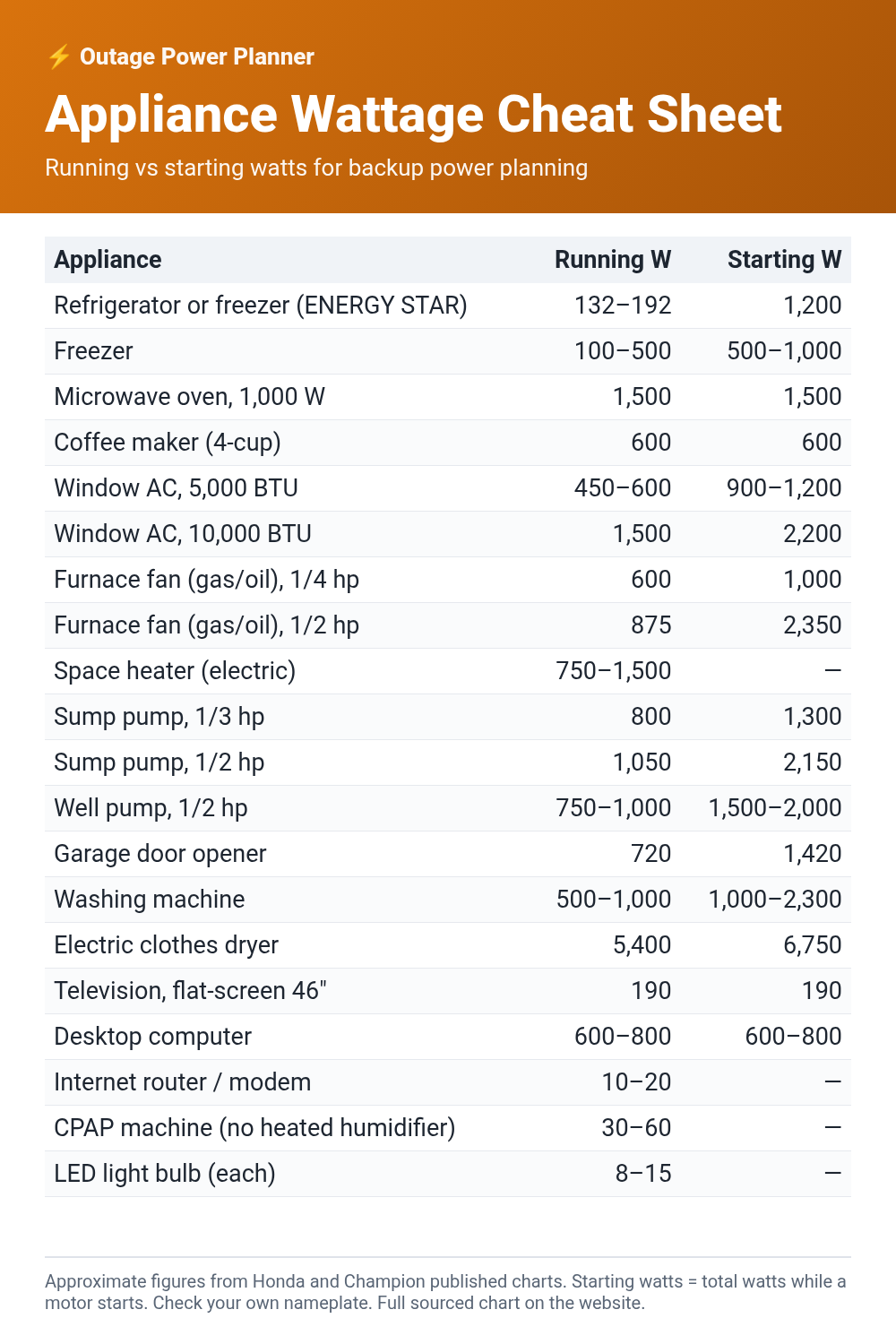
49 appliances, each with a cited source. Starting watts are the brief surge a motor needs to start; running watts are what it draws while operating.
Read this first. All values are approximate as published by the source. Check the label on your own equipment. Rows tagged estimate come from third-party sites and are typical values, not our measurements. Where a source gives a range, the calculators use the upper end so you don’t undersize.
| Appliance | Category | Running W | Starting W | Basis | Source | Notes |
|---|---|---|---|---|---|---|
| Refrigerator or freezer (ENERGY STAR) | Kitchen | 132–192 | 1,200 | approx. (manufacturer) | Honda Power Equipment | Honda lists a second example elsewhere (1,600 start / 200 run); see our fridge article. |
| Refrigerator (typical range) | Kitchen | 150–400 | 800–1,200 | approx. (manufacturer) | Champion Power Equipment | Calculators use the upper end. |
| Freezer | Kitchen | 100–500 | 500–1,000 | approx. (manufacturer) | Champion Power Equipment | Calculators use the upper end. |
| Microwave oven, 650 W | Kitchen | 1,000 | 1,000 | approx. (manufacturer) | Honda Power Equipment | Rated output watts are lower than the watts drawn from the outlet. |
| Microwave oven, 1,000 W | Kitchen | 1,500 | 1,500 | approx. (manufacturer) | Honda Power Equipment | Champion lists a broader 600–1,200 W range for microwaves. |
| Coffee maker (4-cup) | Kitchen | 600 | 600 | approx. (manufacturer) | Honda Power Equipment | |
| Dishwasher (cool-dry cycle) | Kitchen | 216 | 540 | approx. (manufacturer) | Honda Power Equipment | Heated cycles draw far more; see next row. |
| Dishwasher (heated cycle) | Kitchen | 1,200–2,400 | — | approx. (manufacturer) | Champion Power Equipment | No starting figure listed by source. |
| Electric fry pan | Kitchen | 1,500 | 1,500 | approx. (manufacturer) | Honda Power Equipment | |
| Electric range, one 8-inch element | Kitchen | 2,100 | 2,100 | approx. (manufacturer) | Honda Power Equipment | Champion lists 1,200–2,400 W per burner. Usually a 240 V appliance. |
| Window AC, 5,000 BTU | Heating & cooling | 450–600 | 900–1,200 | approx. (manufacturer) | Champion Power Equipment | Calculators use the upper end. |
| Window AC, 10,000 BTU | Heating & cooling | 1,500 | 2,200 | approx. (manufacturer) | Honda Power Equipment | Champion lists 900–1,200 W running / 1,800–2,400 W starting for the same size. |
| Central AC, 2-ton | Heating & cooling | 2,000–2,500 | 3,500–4,500 | approx. (manufacturer) | Champion Power Equipment | Usually 240 V. Calculators use the upper end. |
| Central AC, 3-ton | Heating & cooling | 3,000–3,500 | 5,000–6,000 | approx. (manufacturer) | Champion Power Equipment | Usually 240 V. Calculators use the upper end. |
| Central AC, 4-ton | Heating & cooling | 4,000–5,000 | 6,500–8,000 | approx. (manufacturer) | Champion Power Equipment | Usually 240 V. Calculators use the upper end. |
| Furnace fan (gas/oil), 1/8 hp | Heating & cooling | 300 | 500 | approx. (manufacturer) | Honda Power Equipment | |
| Furnace fan (gas/oil), 1/4 hp | Heating & cooling | 600 | 1,000 | approx. (manufacturer) | Honda Power Equipment | |
| Furnace fan (gas/oil), 1/3 hp | Heating & cooling | 700 | 1,400 | approx. (manufacturer) | Honda Power Equipment | |
| Furnace fan (gas/oil), 1/2 hp | Heating & cooling | 875 | 2,350 | approx. (manufacturer) | Honda Power Equipment | Champion lists 300–800 W running / 800–1,600 W starting for a 1/2 hp furnace fan. |
| Space heater (electric) | Heating & cooling | 750–1,500 | — | approx. (manufacturer) | Champion Power Equipment | Resistive load; no extra starting watts listed. |
| Electric water heater | Heating & cooling | 4,500 | 4,500 | approx. (manufacturer) | Honda Power Equipment | Champion lists 3,000–4,500 W. Usually 240 V. |
| Window fan | Heating & cooling | 50–200 | — | approx. (manufacturer) | Champion Power Equipment | |
| Ceiling fan | Heating & cooling | 15–75 | — | approx. (manufacturer) | Champion Power Equipment | |
| Sump pump, 1/3 hp | Water & garage | 800 | 1,300 | approx. (manufacturer) | Honda Power Equipment | Champion lists 500–800 W running / 1,000–1,600 W starting. |
| Sump pump, 1/2 hp | Water & garage | 1,050 | 2,150 | approx. (manufacturer) | Honda Power Equipment | Champion lists 800–1,050 W running / 1,300–2,150 W starting. |
| Well pump, 1/2 hp | Water & garage | 750–1,000 | 1,500–2,000 | approx. (manufacturer) | Champion Power Equipment | Calculators use the upper end. |
| Well pump, 1 hp | Water & garage | 1,000–2,000 | 2,000–4,000 | approx. (manufacturer) | Champion Power Equipment | Calculators use the upper end. |
| Garage door opener | Water & garage | 720 | 1,420 | approx. (manufacturer) | Honda Power Equipment | |
| Washing machine | Laundry | 500–1,000 | 1,000–2,300 | approx. (manufacturer) | Champion Power Equipment | Honda lists 1,200 W for an automatic washer. |
| Electric clothes dryer | Laundry | 5,400 | 6,750 | approx. (manufacturer) | Honda Power Equipment | Champion lists 4,000–6,000 W. Usually 240 V. |
| Television, flat-screen 20" | Electronics & comms | 120 | 120 | approx. (manufacturer) | Honda Power Equipment | |
| Television, flat-screen 46" | Electronics & comms | 190 | 190 | approx. (manufacturer) | Honda Power Equipment | Champion lists 80–400 W for 32"–55" TVs. |
| Laptop computer | Electronics & comms | 200–250 | 200–250 | approx. (manufacturer) | Honda Power Equipment | |
| Desktop computer | Electronics & comms | 600–800 | 600–800 | approx. (manufacturer) | Honda Power Equipment | |
| Monitor (LCD) | Electronics & comms | 30 | 30 | approx. (manufacturer) | Honda Power Equipment | |
| Printer | Electronics & comms | 400–600 | 400–600 | approx. (manufacturer) | Honda Power Equipment | |
| Radio | Electronics & comms | 50–200 | 50–200 | approx. (manufacturer) | Honda Power Equipment | |
| Internet router / modem | Electronics & comms | 10–20 | — | approx. (manufacturer) | Champion Power Equipment | |
| Phone / laptop charger | Electronics & comms | 20–100 | — | approx. (manufacturer) | Champion Power Equipment | |
| Home security system | Electronics & comms | 15–40 | — | approx. (manufacturer) | Champion Power Equipment | |
| CPAP machine (no heated humidifier) | Medical & lighting | 30–60 | — | approx. (manufacturer) | Champion Power Equipment | Medical-device users: confirm your own device’s rating and plan backup power with your provider. |
| CPAP machine (heated humidifier) | Medical & lighting | 60–120 | — | approx. (manufacturer) | Champion Power Equipment | Same caution as above. |
| LED light bulb (each) | Medical & lighting | 8–15 | — | approx. (manufacturer) | Champion Power Equipment | |
| Wi-Fi access point (not PoE-powered) | Home lab (estimates) | 6–12 | — | estimate | RACKDENSITY | Idle–load typical values; measure your own with a plug meter. |
| Switch, 8-port unmanaged | Home lab (estimates) | 4–5 | — | estimate | RACKDENSITY | Idle–load typical values. |
| Router / firewall appliance | Home lab (estimates) | 12–18 | — | estimate | RACKDENSITY | Idle–load typical values. |
| Mini PC, Intel N100-class (light load) | Home lab (estimates) | 8–10 | — | estimate | MiniPCLab | MiniPCLab lists ~5.5–6.5 W idle and 14–18 W full load for N100 mini PCs. |
| Mini PC, 6–8 core | Home lab (estimates) | 12–50 | — | estimate | RACKDENSITY | Idle 12 W / load 50 W typical values. |
| NAS, 4 bays, HDDs spinning | Home lab (estimates) | 30–45 | — | estimate | RACKDENSITY | Idle–load typical values. |
Dash (—) = the source lists no separate starting figure (calculators treat starting = running).
Methodology
- Sources. Every row links to its source page: Honda Power Equipment (Manufacturer chart (approximate)); Champion Power Equipment (Manufacturer chart (approximate)); RACKDENSITY (Third-party typical value (ESTIMATE)); MiniPCLab (Third-party measured/typical (ESTIMATE)).
- Ranges. Published ranges are shown in full; calculators use the upper bound.
- Starting watts. We treat the published starting figure as the total watts drawn while the motor starts (as Honda and Champion define it). The generator calculator shows two results — the standard method (running total + the largest starting-minus-running difference) and a more conservative method (running total + the largest listed starting figure).
- Not included. We don’t publish averages we can’t source. Fridge average watts depend on the unit; see the refrigerator guide for how to compute it from the EnergyGuide label.
- Found an error? Email contact@poweroutageplan.com with the page and a source (see the editorial policy).